Costume Design
The Giant's Robe, Blood, and the Unnatural
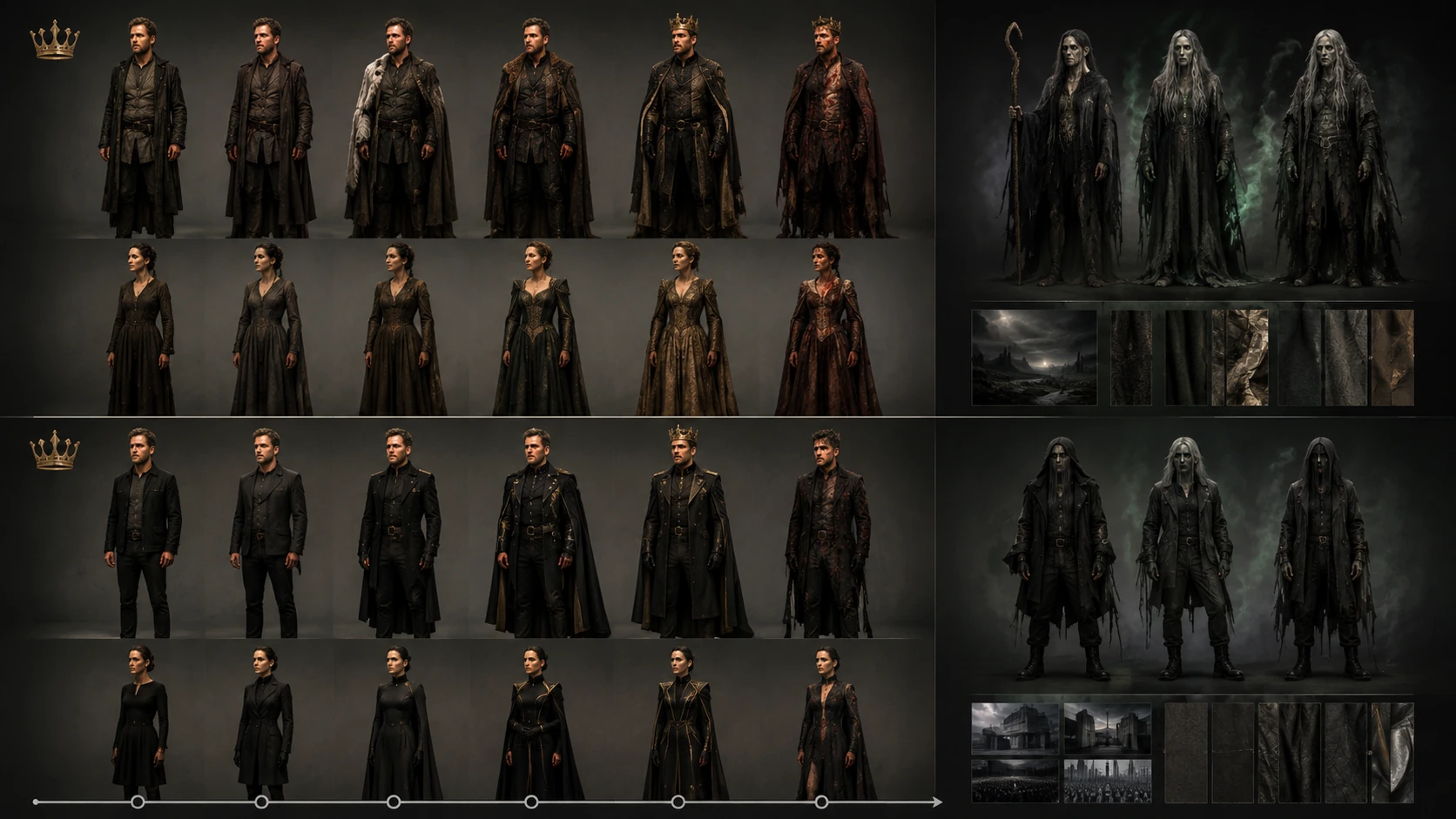
What this task rewards: Visual Metaphor
Don’t just describe “nice costumes”. Strong response answers show how costume tracks psychological decay. Macbeth’s costume should degrade as guilt grows; Lady Macbeth’s structured dominance should collapse into vulnerability by Act 5. Costume is a visible map of guilt, status and control.
The Giant's Robe
Angus describes Macbeth’s title as hanging loose about him “like a giant's robe upon a dwarfish thief.” Costume can make the metaphor physical: the audience should see him as an imposter.
👑 The Ill-Fitting Crown
In Act 3+, Macbeth’s crown should sit too large, slipping and forcing adjustment. Use heavy, dull metal (brass/iron) so it reads as burden, not glory. The audience reads status as unstable and undeserved.
🧥 The Dwarfish Thief
The royal mantle must be oversized: hem dragging, shoulders swallowing the actor. Deep purple velvet with fur lining can look impressive, but the key is scale — the costume visually “drowns” Macbeth, proving he cannot carry kingship.
The Stain of Guilt
Blood becomes an active costume motif. It accumulates through the play, turning guilt into something visible and permanent. Design the stains as a timeline: clean hero → butchered tyrant.
🩸 Macbeth's Armour
Act 1 armour is clean and polished (noble warrior). By Act 5 it should be tarnished, battered, rusted and permanently stained with dark dried blood. The deterioration turns his body into evidence of moral decay.
👗 Lady Macbeth's Nightgown
In Act 5, costume her in thin white cotton: fragile, exposed, unarmoured. White suggests innocence, so the contrast with her guilt becomes tragic. The audience reads collapse through softness and vulnerability.
The Unearthly Witches
Banquo notes they “should be women” yet their beards confuse identity. Costume should make them look androgynous and non-human: a corrupted extension of the heath rather than recognisable people.
🌿 Textures of the Earth
Use coarse distressed fabrics (hessian/burlap), caked mud, dead twigs and frayed hems. Weathering is essential: they should look born from a ruined landscape. Texture does the storytelling before dialogue.
🎭 Androgynous Silhouettes
Avoid stereotypes. Bind/flatten silhouettes and layer drab greys to obscure human shape. Add asymmetry and rough construction so the body reads “wrong”. This taps into Jacobean fears of identities outside patriarchal order.
📝 Eduqas: Costume Exam Builder
Generate a model paragraph linking costume to intention and audience impact.
Click “Draw New Concept” to generate an integrated costume paragraph...
Synopsis & Journeys
Track the tragic descent from war hero to tyrant king.
Context & History
King James I, witchcraft, and the Divine Right of Kings.
Characters & Acting
Playing guilt, supernatural possession, and shifting status.
Scenes & Proxemics
Interactive staging for the Witches, Banquets, and Battles.
Themes & Quotes
Ambition, the supernatural, and corrupted masculinity.
Design Elements
Castles, heaths, bloody costumes, and supernatural lighting.