Context & History
King James I, Witchcraft, and Regicide
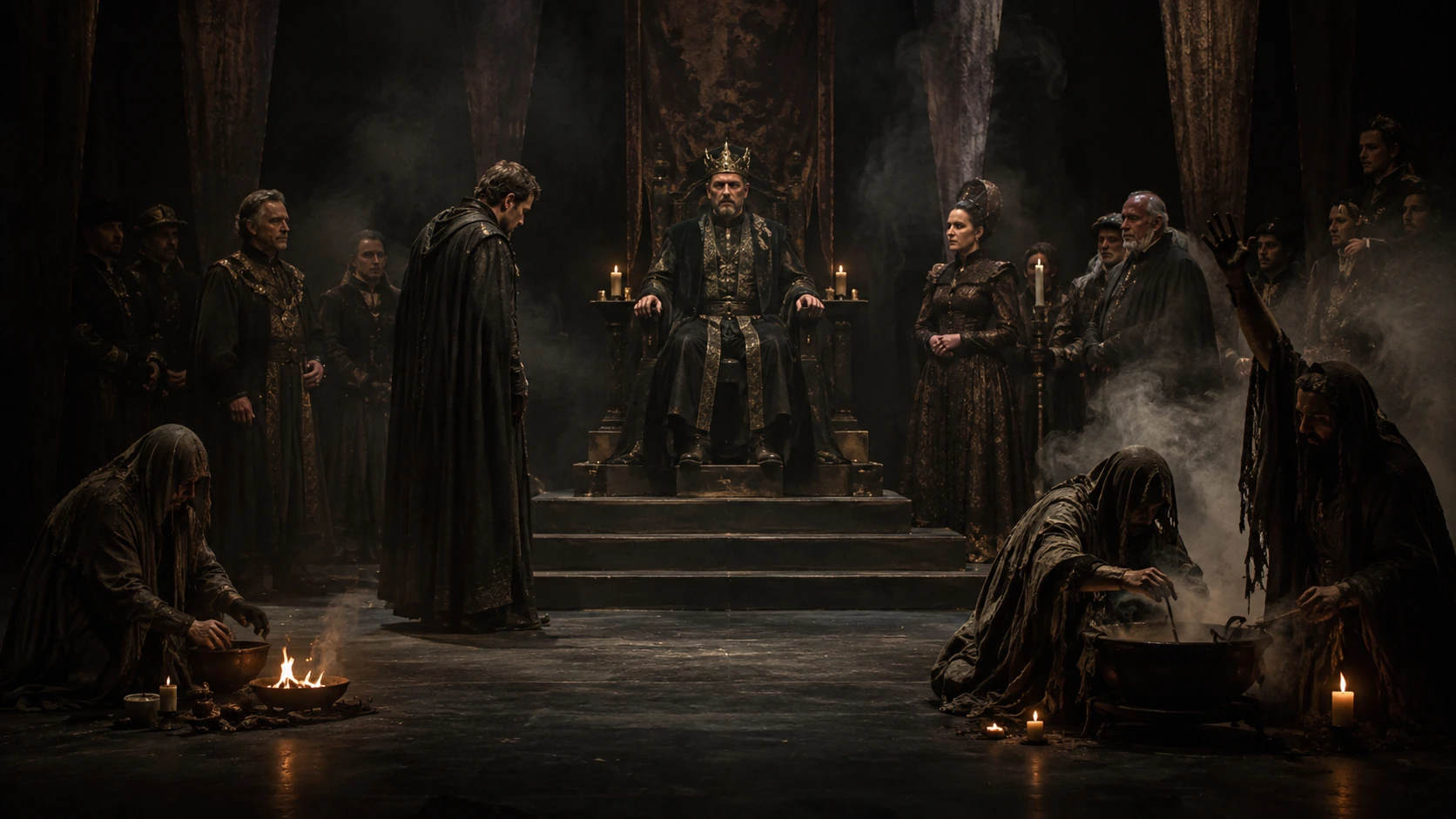
The Common weakness: The "History Essay"
Context only earns marks when it becomes a stage choice. Don’t just state “Jacobeans feared witches”. Translate it: “Because Jacobeans feared witchcraft, I would use unsettling non-naturalistic movement, choral speaking, and sickly uplighting to disturb the audience.”
The Jacobean Worldview
Click through the contextual pillars of the period and see how to convert each idea into high-scoring acting/directing/design choices.
The Gunpowder Plot & Paranoia
Macbeth was written in 1606, shortly after the failed Gunpowder Plot of 1605 (an attempt to assassinate King James I). Shakespeare wrote the play to flatter James (who traced his ancestry to Banquo) and to act as propaganda: a warning against treason. The era was thick with paranoia, spies, and fear of hidden traitors.
🎭 Acting Application
If your Act 3 concept foregrounds political paranoia, make it visible through a controlled combination of eye line, breath, vocal restraint and changing proxemics. Checking over the shoulder or widening distance are possible choices, not “Jacobean” acting rules.
🎨 Design Application
Use intense chiaroscuro lighting (deep contrast) so characters step in and out of shadow. Hidden faces become a visual metaphor for betrayal, equivocation, and danger inside the court.
The Divine Right of Kings
Jacobeans believed in the “Great Chain of Being” — a strict hierarchy with God at the top, then the King, then men, women, animals and earth. The King was chosen by God (Divine Right), so regicide wasn’t just murder: it was a sin that “broke” the natural order and plunged nature into chaos.
🎭 Acting Application
After the murder, you could physicalise guilt through disrupted breath, stillness, shaking hands or a change in posture. Choose only the details that fit your interpretation and make the contrast with the pre-murder scene readable.
🎨 Design Application
Use sound design to communicate “nature rebelling”: unnatural thunder cracks, owls shrieking, distant animal cries. The soundscape overwhelms the audience so the world feels broken immediately after regicide.
Daemonologie & The Supernatural
Witchcraft was not a fairy tale to Jacobeans — it was feared and criminalised. James I even wrote Daemonologie, a text on witch-hunting. Jacobean beliefs about witchcraft give the Witches a powerful context for danger, uncertainty and prophecy. A production still has to decide how literally supernatural they appear.
🎭 Acting Application
One concept could break naturalism through choral speaking, synchronised movement or unusual levels. Another could make the Witches recognisably human. Whichever route you choose, explain how it shapes the audience’s response to prophecy and responsibility.
🎨 Design Application
If you want an uncanny supernatural image, low-angle light can distort familiar facial planes and cast upward shadows. If your Witches are more human, use a less stylised state. The design should serve the production’s interpretation, not a fixed “demonic” look.
Subverting Jacobean Patriarchy
Jacobean society was patriarchal: women were expected to be submissive and quiet. Lady Macbeth is terrifying because she subverts this: she rejects femininity (“unsex me here”) and dominates her husband to force the murder into existence.
🎭 Acting Application
In Act 1, one option is to let Lady Macbeth close distance, take a higher level or control eye line while Macbeth yields space. Another production could make her influence quieter. What matters is that the physical relationship supports your interpretation of persuasion and power.
🎨 Design Application
Track her arc through costume: structured, controlled silhouettes early (deep reds, sharp lines), shifting to frayed whites by Act 5 to visualise vulnerability and psychological collapse.
📝 Eduqas: The Exam Builder
Generate a model paragraph converting context into acting/directing/design choices.
Click “Draw New Context Link” to generate an integrated exam paragraph...
Synopsis & Journeys
Track the tragic descent from war hero to tyrant king.
Context & History
King James I, witchcraft, and the Divine Right of Kings.
Characters & Acting
Playing guilt, supernatural possession, and shifting status.
Scenes & Proxemics
Interactive staging for the Witches, Banquets, and Battles.
Themes & Quotes
Ambition, the supernatural, and corrupted masculinity.
Design Elements
Castles, heaths, bloody costumes, and supernatural lighting.