Face Plot Summary & Structure
A practical summary of what happens — and how the structure shapes Martin’s journey.
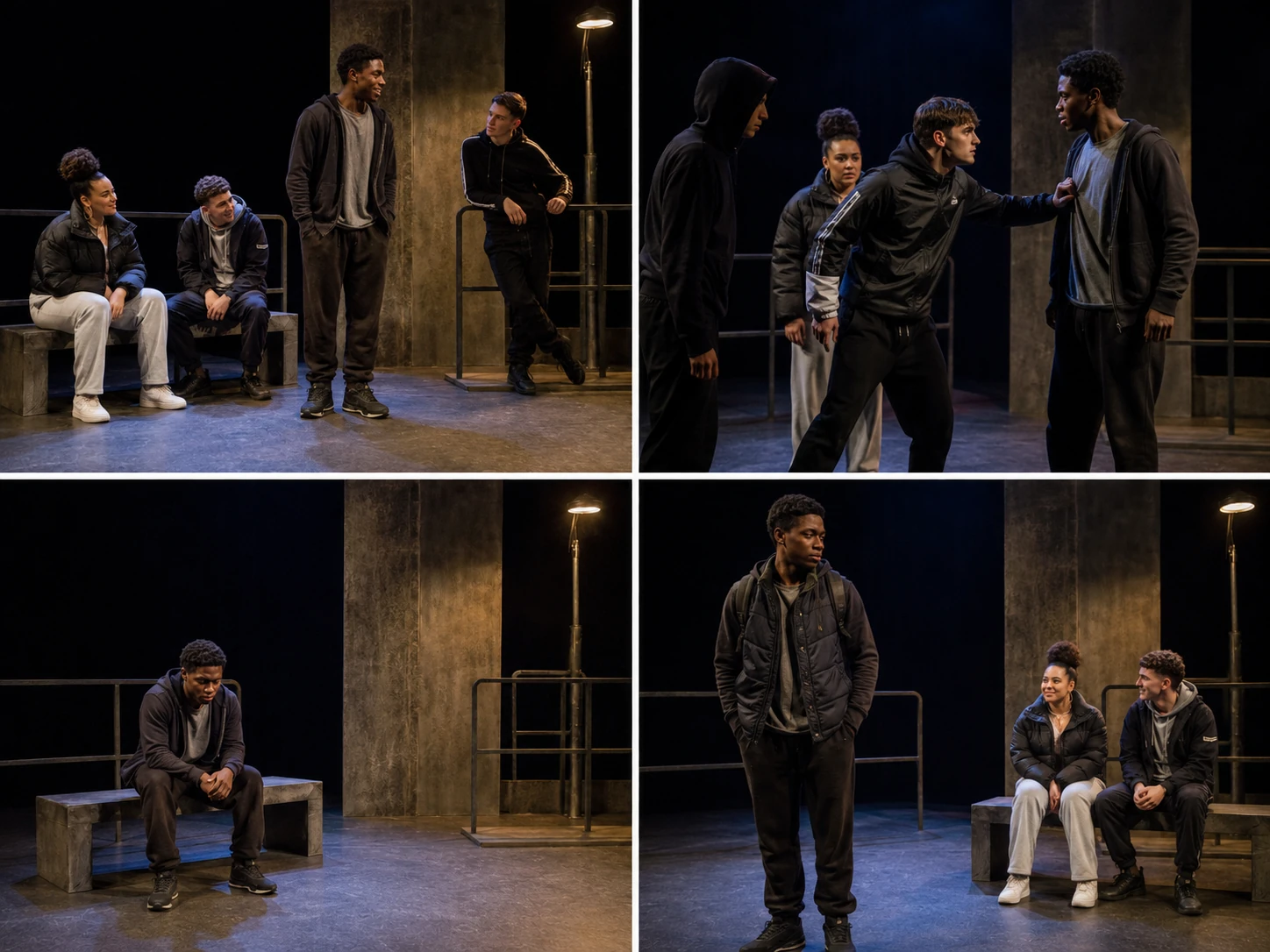
Structure prompt: which change in Martin’s body or spacing marks the biggest turning point?
Face plot summary
Face follows Martin Turner, a teenage boy whose identity is tied to image, friendship and belonging. At the start he performs confidence and racist bravado, but after a violent attack leaves him badly scarred he is forced to confront the values and loyalties that previously shaped him. The play explores how appearance affects how people judge him, how his relationships shift after the attack and how Martin begins to rethink who he wants to be.
The structure is episodic, so a production can move quickly between home, hospital, public spaces and moments of social confrontation. That pace matters: the audience sees Martin’s transformation not as one single revelation, but as a series of uncomfortable recognitions.
The story in eight turning points
1. Martin performs belonging
Early scenes establish his swagger, his concern with image and the peer group that helps define him. He appears secure, but that confidence is partly performance.
2. Prejudice is normalised
The language and behaviour around Martin show how racism and masculine posturing can become part of everyday group identity rather than a shocking exception.
3. The attack changes everything
A violent assault damages Martin’s face. The attack is both a plot event and a theatrical pivot: after this point, the audience reads every interaction through the lens of injury, visibility and vulnerability.
4. Recovery becomes public as well as private
Hospital scenes and early aftermath moments reveal pain, dependence and fear. Martin is no longer able to control how others see him.
5. Relationships start to expose fault-lines
People who mattered before the attack are revealed differently afterwards. Some responses offer care; others expose prejudice, discomfort or selfishness.
6. Martin sees his old self more clearly
The play begins to show the cost of the identity he previously embraced. His assumptions about race, masculinity and status are no longer secure.
7. The pressure to return to the old image increases
Other characters and social expectations may try to pull Martin back into earlier attitudes. This creates tension between change and regression.
8. Identity becomes a conscious choice
By the end, the central question is not simply what Martin looks like, but who he chooses to be. The play ends with the audience considering whether visible damage can produce moral or emotional clarity.
Character journey at a glance
| Stage | Martin’s state | What the audience should notice | Acting implication |
|---|---|---|---|
| Beginning | Confident, image-conscious, group-defined | His identity is socially performed and partly borrowed from the people around him. | Use easy physical confidence, quick reactions and a certainty that fills the space. |
| Immediately after the attack | Shocked, vulnerable, disrupted | The loss of control over appearance changes how others read him. | Show physical pain, guarded movement and uncertainty around eye contact and space. |
| Mid-play | Angry, defensive, increasingly reflective | He is caught between old loyalties and new understanding. | Shift between bursts of aggression and quieter moments where thought slows the body down. |
| End | More self-aware, morally unsettled | The play asks whether he has genuinely changed, and what that change costs. | Find a less performed physicality: fewer swaggering gestures, more deliberate stillness and listening. |
Why the structure matters in performance
Because the play is episodic, each scene needs a clear dramatic job. Transitions can do real storytelling work: a quick shift from public noise to hospital quiet, or from confident movement to restricted movement, can make Martin’s transformation visible even before he speaks.
Next step
Move to Characters & Acting to turn the plot summary into playable relationships and performance choices.