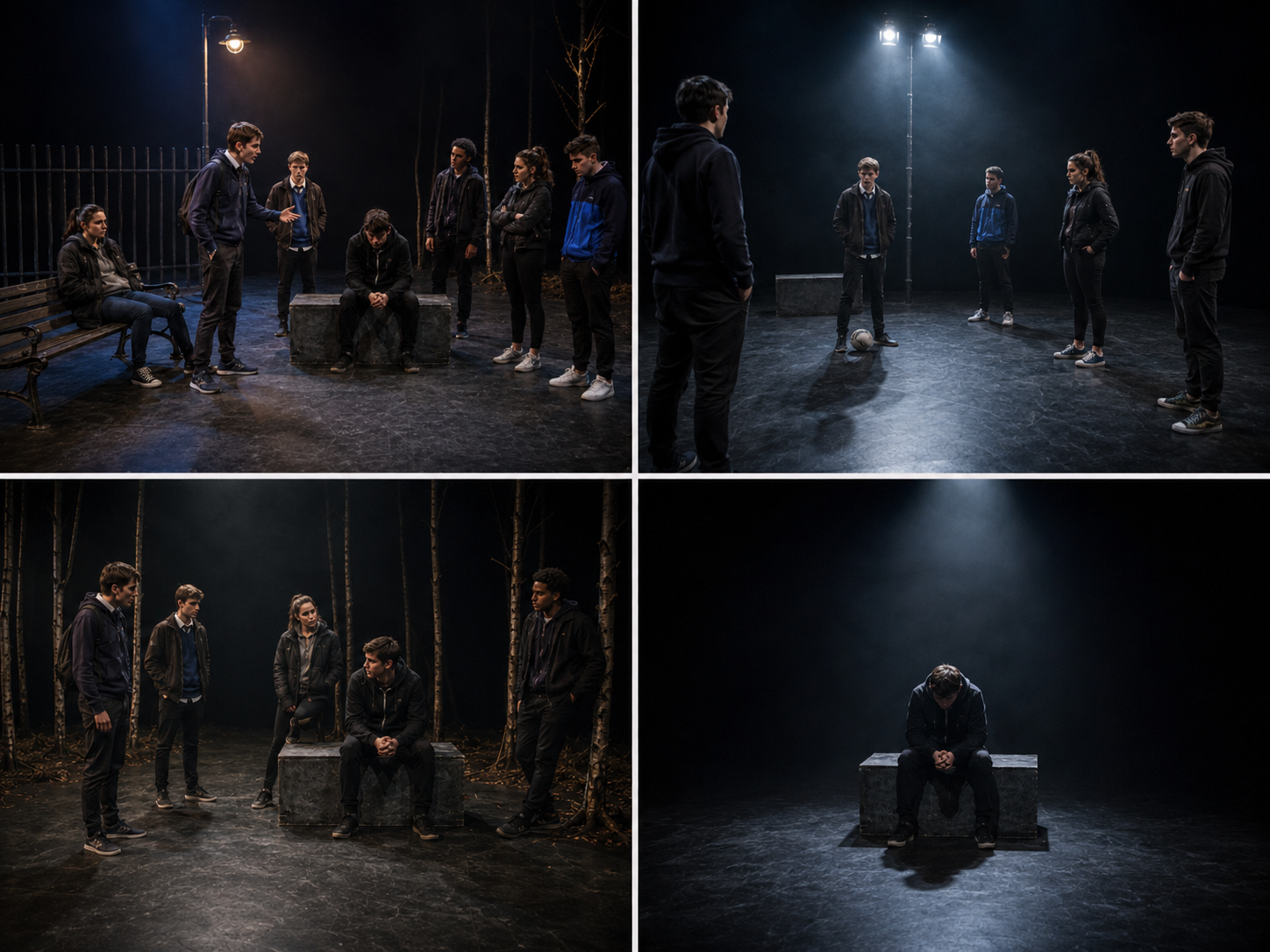
Street · opening
Jan and Mark reveal that someone is dead
The pair have to create suspense while giving the audience incomplete information.
Stage pictureKeep them close enough to feel like a unit, but avoid full eye contact so the news feels difficult to face directly.
Actor focusShared rhythm, clipped exchanges and a small break in the pattern when the seriousness lands.
Field · early section
Leah talks while Phil eats
The scene works because the audience watches two very different kinds of behaviour at once.
Stage pictureGive Phil a settled position and let Leah repeatedly enter and leave his personal space.
Actor focusLeah changes tactics. Phil changes very little. His refusal to respond becomes active.
Wood · section one
John Tate loses control and Phil takes over
This is one of the clearest status changes in the play.
Stage pictureStart with bodies angled towards John Tate, then allow the formation to reorient around Phil as the plan takes shape.
Actor focusJohn Tate spends energy holding power. Phil gains it by appearing to have an answer.
Field · section two
Brian refuses to identify the postman
The cover-up becomes deliberate harm to someone outside the group.
Stage pictureLeave Brian an exit route at first, then close it as pressure increases. Phil does not need to chase him.
Actor focusTrack Brian’s breathing, eye line and level. His body can show the decision before the words do.
Wood · section three
Adam returns
The group now has to look at the person whose supposed death has organised everything they have done.
Stage pictureGive Adam visible space at first. Let the group close around him only when self-protection starts to take over.
Actor focusAdam’s injured, disjointed behaviour should read as vulnerable and human. The horror comes from the group’s choice.
Field · final section
Richard talks to Phil after Leah has gone
The final scene echoes earlier Phil/Leah scenes without recreating the same relationship.
Stage pictureLeave a noticeable empty area where Leah used to move. Richard can occupy some of it without replacing her.
Actor focusUse silence and reduced movement. Phil’s changed relationship with food can become a quiet visual sign that the old pattern has broken.