Historical Context & Staging
1912 vs 1945, Socialism & The Daldry Revolution
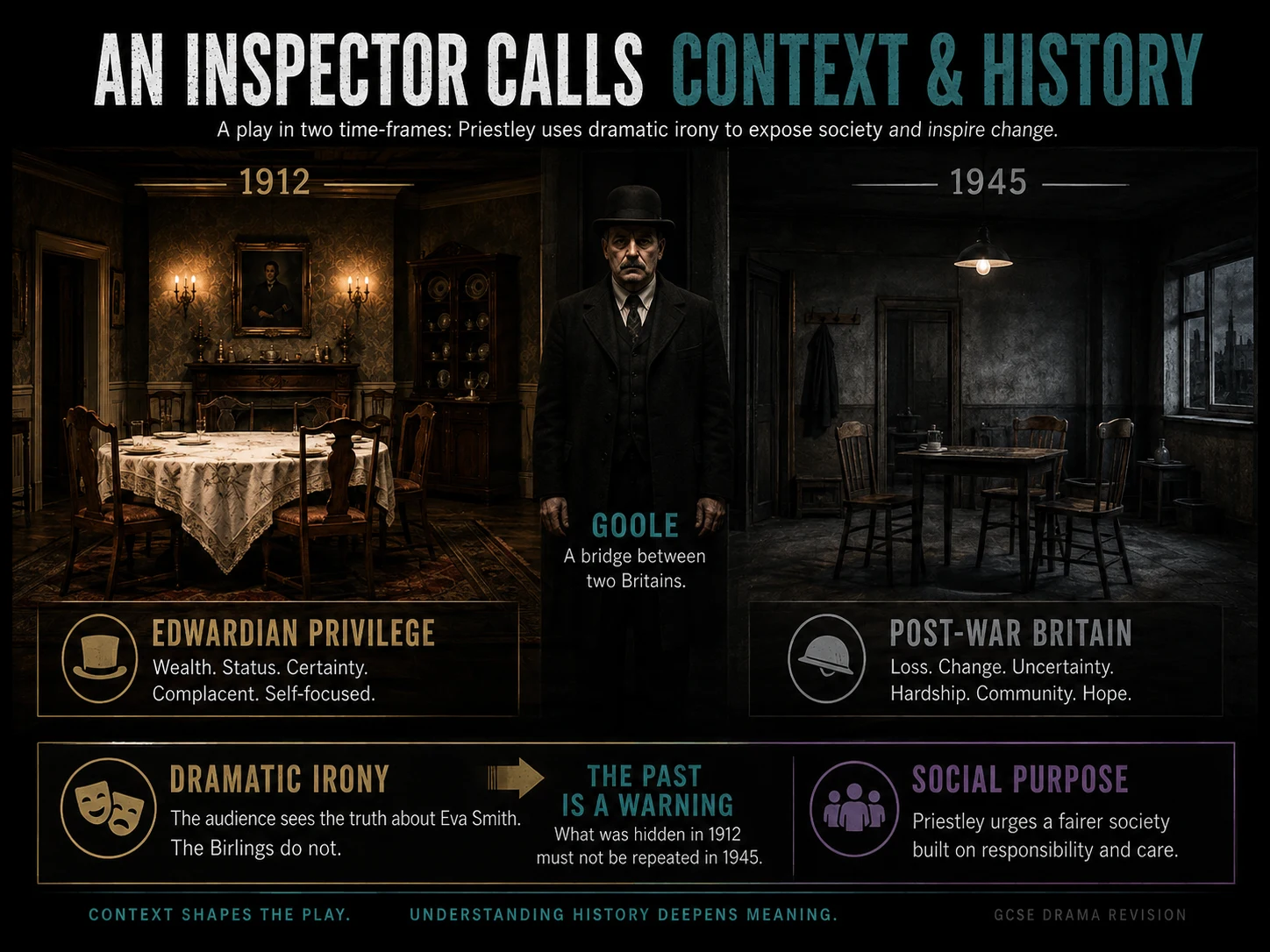
AO3 prompt: how does the time gap make Birling’s confidence look foolish to the audience?
What this task rewards: AO3 (Context)
To access the higher levels of response in Component 3, you cannot just describe a costume or lighting cue. You must explicitly link your design and acting choices back to the social, historical, and theatrical context of the play. For Priestley, this means demonstrating how your staging communicates his core socialist message to the audience.
⏳ The Time Jump: 1912 vs 1945
The play was written in 1945 (just as WWII ended) but is set in 1912 (just before WWI). This 33-year gap is Priestley's primary theatrical weapon.
- 1912 (The Setting): The Edwardian era. A time of extreme class inequality, rigid social hierarchies, and capitalist complacency. Men like Birling believed an unsinkable Titanic and endless prosperity were guaranteed.
- 1945 (The Audience): A society traumatized by two World Wars and the Great Depression. However, they were also hopeful, having just voted in a landslide Labour government to build the Welfare State.
Priestley uses dramatic irony to make Birling look foolish to the 1945 audience, instantly discrediting capitalism.
✊ Capitalism vs. Socialism
J.B. Priestley was a prominent socialist broadcaster during WWII. He co-founded the Common Wealth Party, advocating for public ownership and a new morality in politics.
- Capitalism (The Birlings): Arthur Birling represents the capitalist viewpoint: "a man has to make his own way—has to look after himself." He views Eva Smith not as a human, but as cheap labour to keep costs down and prices up.
- Socialism (The Inspector): Goole acts as Priestley's mouthpiece. He preaches collective responsibility: "We don't live alone. We are members of one body." He warns that if society does not learn this lesson, they will be taught it in "fire and blood and anguish" (the World Wars).
🌍 The Moscow Premiere
Surprisingly, An Inspector Calls did not premiere in London. It premiered in Moscow in 1945 at the Kamerny Theatre and the Leningrad Comedy Theatre.
The play premiered in the Soviet Union in 1945 and reached London at the New Theatre in 1946. That unusual route is useful historical context, but avoid inventing a single motive for it or treating the Moscow premiere as a required staging style. In an exam, connect the 1912 setting and 1945 audience to a concrete performance or design choice you can justify.
🏚️ Stephen Daldry's 1992 Revival
While the 1946 original was pure realism, strong Drama students frequently reference Stephen Daldry's legendary 1992 National Theatre production. It redefined how the play is staged.
- The Expressionist Set: The Birling home was staged as an oversized, precarious dollhouse elevated on stilts above a bleak, bombed-out 1945 wasteland.
- The Collapse: As the family's lies were exposed, the physical house leaned forward, its hinges breaking, spilling the Birlings and their fine china out into the dirt with the working class.
- The Meaning: Daldry visually destroyed the Edwardian class system on stage, forcing the 1912 characters to physically confront the 1945 reality.
✍️ Contextual Design Generator
Click the button to generate a high-level exam paragraph showing how you would use design to communicate Priestley's 1912/1945 context to a modern audience.
| Directorial/Design Idea | Contextual Justification (Why?) | Keywords to Use |
|---|---|---|
| Click the button above to generate a response... | ||
Related guide
Compare Priestley’s stage directions with professional set design