Characters & Acting
Multi-roling, Narrators, and Gestus
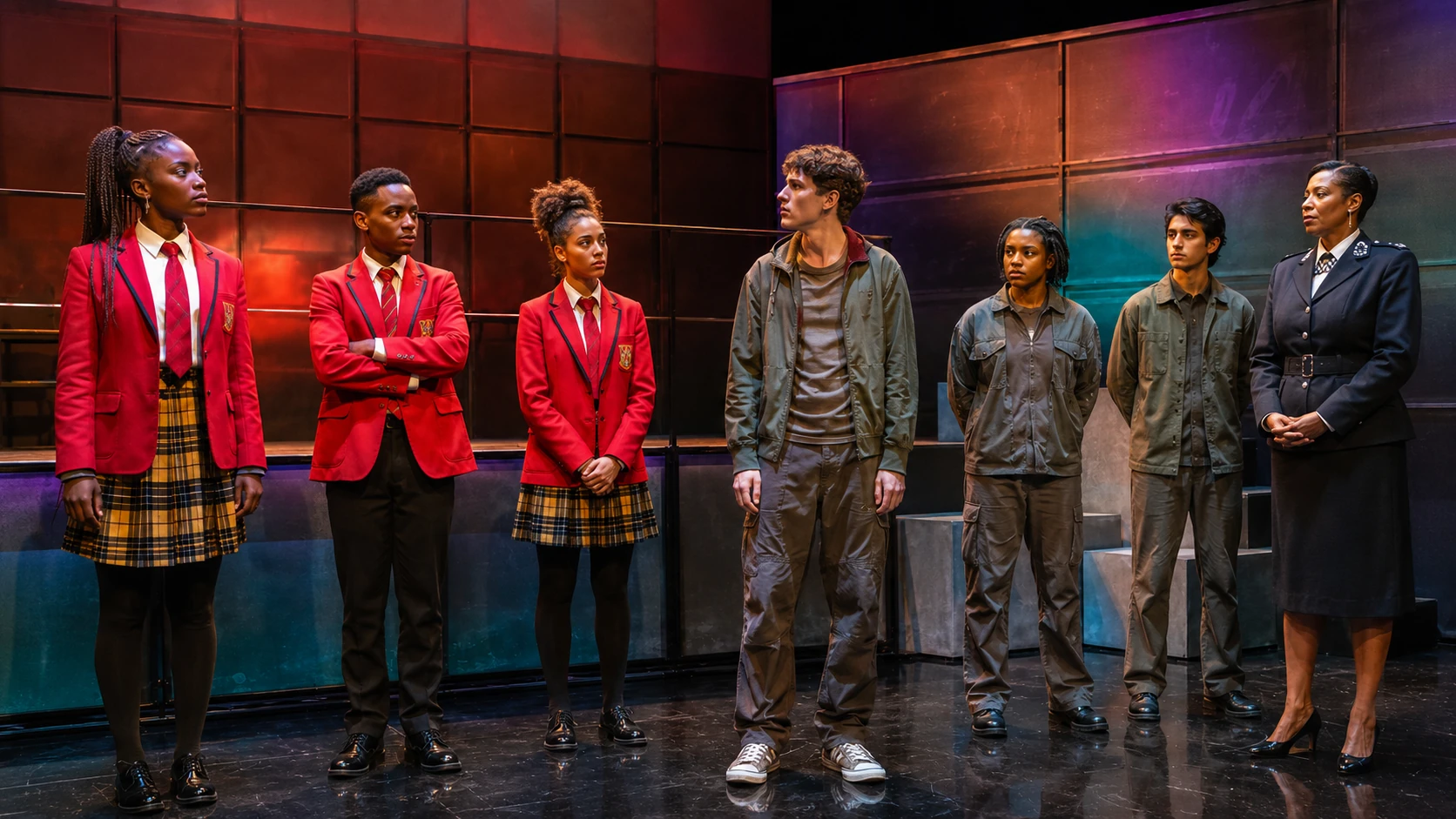
Click a character or the Ensemble to reveal AQA acting notes.
Select a Role
Click a node on the Epic Theatre web to explore physical and vocal acting possibilities for the Cooke adaptation.
The Ensemble (Multi-Roling)
Possible performance approach: visible multi-roling and physical theatre
The Cooke adaptation requires an ensemble to cover many roles. A strong practical response explains how changes in posture, focus, voice and a simple signifier could make each switch immediately legible.
🗣️ Vocal Switch
Change vocal placement, pitch, pace and resonance instantly. For example, a police officer might use measured authority while a frightened or secretive rebel uses a quicker, quieter delivery. Any accent choice should come from a defensible character interpretation, not social stereotyping.
🚶 Physical Switch
Change your physical score. Contrast one role’s upright, controlled stillness with another role’s guarded or restless movement, then add a simple costume signifier in full view if that suits the chosen style.
Callum McGregor
Status: Low (Nought) | Journey: Innocence to Radicalisation
Track how Callum changes as racism, exclusion and political violence reshape his choices. A performance can contrast his earlier openness with greater guardedness, urgency or control later in the play without reducing him to a single “emotionless” state.
🗣️ Vocal Skills
Act 1: You could use a quicker pace, lighter vocal energy or more spontaneous responses.
Act 2: Greater control, lower energy, longer pauses or a more deliberate pace could show how his circumstances have changed. Choose the contrast that fits the exact moment.
🚶 Physical Skills
Physical journey: Decide when Callum is open, guarded, defiant or controlled. Changes in eye focus, muscular tension, personal space and stillness can show shifting status without giving him one compulsory posture for each act.
Sephy Hadley
Status: High (Cross) | Journey: Naivety to Defiance
Sephy begins with massive social privilege but absolute naivety. Her physical journey is about shedding her sheltered posture and learning to use her Cross status to fight the system.
🗣️ Vocal Skills
Act 1: Light, airy tone with rising intonation.
Act 2: Sharp, definitive articulation and increased volume when confronting her father.
🚶 Physical Skills
Proxemics: Initially moves fluidly, unaware of segregation "rules". Later, she learns to use spatial dominance (standing upstage-center) to wield her Cross authority.
The Narrator Role
Text and performance focus: narration and direct address
Where the text moves into narration or direct address, explain how the actor would mark the transition through focus, stance, vocal quality and relationship with the audience.
👁️ Eye Contact
Make the switch into narration legible. You might change eye focus towards the audience, alter stance, step out of the scene or change vocal placement; choose a transition that suits the staging and the exact moment.
⚖️ The Audience as Jury
Direct address can change the audience relationship by asking them to consider the events more consciously. Explain what you want the audience to notice or question at that precise moment rather than assuming one automatic effect.
Kamal Hadley
Status: Maximum (Cross)
Kamal holds major political and family authority. A performance might make that power visible through controlled stillness, confident timing, spatial dominance or the way other characters respond to him.
🗣️ Vocal Skills
Slow, measured pace and a controlled, polished vocal quality. He may not need to shout because he expects to be obeyed instantly; accent is a directorial choice rather than a marker of status by itself.
🚶 Physical Skills
Upright, expansive posture. He takes up space effortlessly and often forces other actors to move around him, dictating the proxemics of the stage.
Jude McGregor
Status: Low (Nought)
Jude's anger at racism develops into commitment to political violence. Track when he persuades, threatens, strategises, listens or loses control so the performance has variation rather than treating him as rage in human form.
🗣️ Vocal Skills
Sudden changes of pace or volume, clipped articulation, interruption or a tightly controlled threat are all possible. Vary the pressure so moments of escalation remain meaningful.
🚶 Physical Skills
Use proxemics, stillness, pace and muscular tension deliberately. Closing distance can intimidate, but holding still or making another actor cross the space can communicate power just as effectively.
📝 AQA Acting Sentence Generator
Use these sentence structures as prompts, then adapt them to the precise moment, prescribed text and intention in the question.
| Acting Choice (What) | Impact Justification (Why) | Key Terminology |
|---|---|---|
| When the actor transitions into their "Narrator" role, I would direct them to break the fourth wall and use direct, prolonged eye contact with the audience. | Direct address changes the audience relationship and can make the political argument harder to ignore. State what you want the audience to notice or question in this particular moment. | Narrator Fourth Wall Direct Address Brechtian |