Blood Brothers Plot Summary & Character Journeys
What happens in the play — and why each turning point matters in performance.
Blood Brothers plot summary
Blood Brothers follows twins Mickey and Edward, separated at birth because their mother, Mrs Johnstone, cannot afford to raise them both. Edward grows up with the wealthy Lyons family while Mickey remains in poverty. The boys meet without knowing they are brothers, form a close friendship and repeatedly cross the class boundary that adults try to enforce. As they grow older, unequal education, employment and opportunity pull their lives apart. Their friendship collapses in the final confrontation, when Mickey learns that Edward is his twin and both brothers are killed.
The opening reveals the ending, so the audience watches the story as a tragedy already in motion. Russell repeatedly asks whether superstition caused the deaths, or whether the real cause was a society that gave the twins radically different chances.
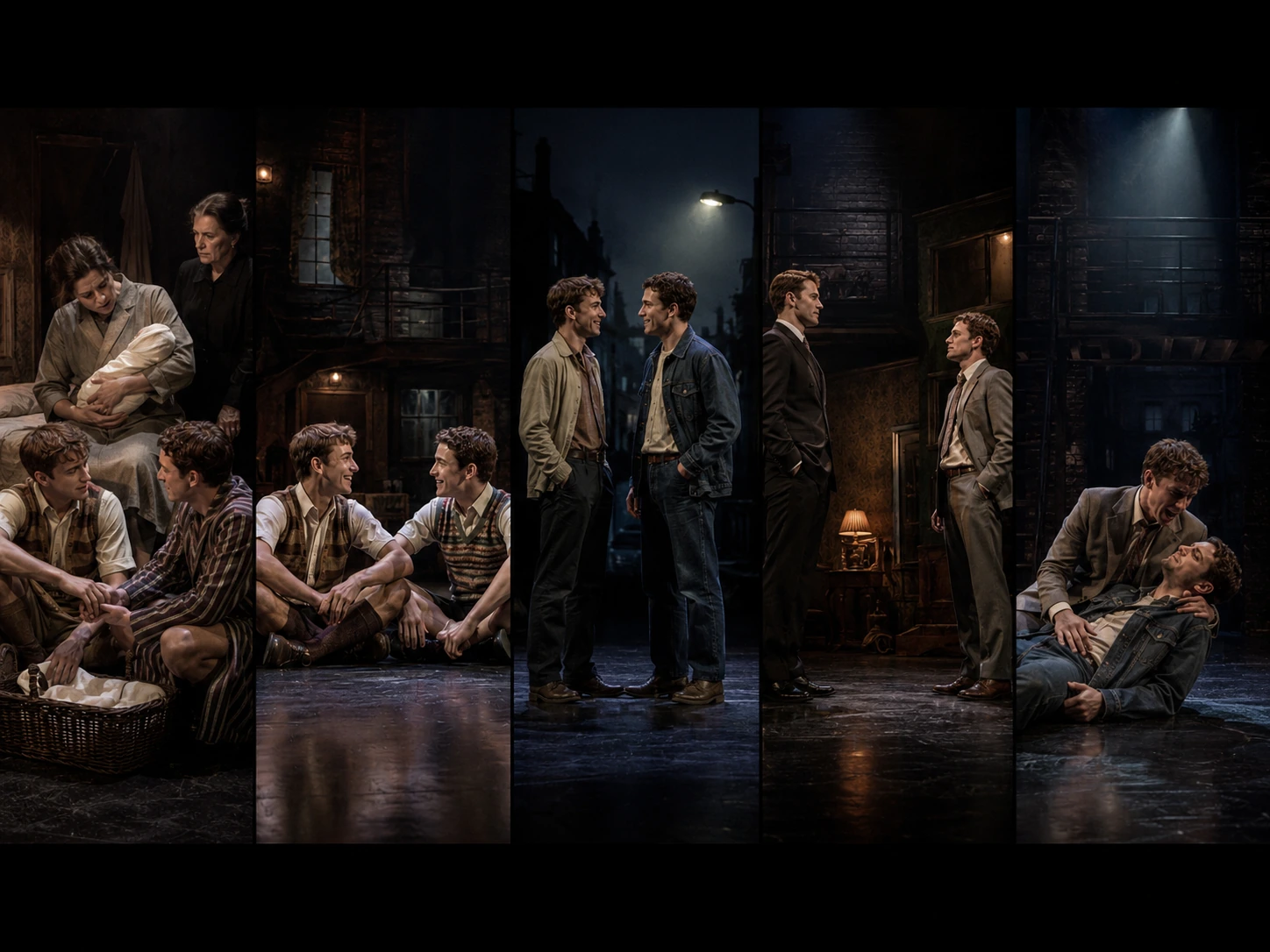
Look closely: At which point do Mickey and Edward stop having genuinely equal choices?
The story in eight turning points
1. Mrs Johnstone discovers she is expecting twins
Debt and insecure work leave her frightened that social services will remove her children. Mrs Lyons recognises her vulnerability and proposes taking one baby.
2. The mothers make the pact
Mrs Johnstone gives Edward to Mrs Lyons and swears on the Bible to keep the arrangement secret. Mrs Lyons then uses superstition to control her.
3. Mickey and Edward meet aged seven
The boys become blood brothers without knowing they are twins. Their contrasting clothes, language and possessions immediately reveal their different classes.
4. The families try to separate them
Mrs Lyons becomes increasingly fearful and the Lyons family moves away. The Narrator keeps returning, turning guilt and secrecy into visible dramatic pressure.
5. The boys reunite as teenagers
The Johnstones are rehoused near the Lyons family. Mickey, Edward and Linda become close, but education and confidence already place Edward on a different path.
6. Adulthood exposes the class divide
Edward goes to university while Mickey loses his factory job. Poverty, a failed robbery and prison damage Mickey’s health and sense of self.
7. Linda asks Edward for help
Edward uses his position to help Mickey’s family. Mickey interprets Linda and Edward’s closeness as betrayal, and resentment replaces childhood loyalty.
8. The council-chamber confrontation
Mrs Johnstone reveals that the men are twins. Mickey realises that he might have lived Edward’s life. Edward is shot, then Mickey is killed by police.
Character journeys at a glance
| Character | Beginning | Turning point | End | Performance implication |
|---|---|---|---|---|
| Mickey | Energetic, imaginative child | Unemployment, prison and medication | Desperate and resentful | Show ageing through pace, posture, vocal energy and shrinking physical confidence. |
| Edward | Polite, protected and curious | Education and social status give him choices | Well-intentioned but unable to understand Mickey’s experience | Keep openness and upright confidence, then expose his shock when privilege cannot solve the crisis. |
| Mrs Johnstone | Warm but financially trapped | The pact and years of secrecy | Forced to tell the truth too late | Balance humour and vitality with recurring flashes of fear whenever the past returns. |
| Mrs Lyons | Controlled and persuasive | Fear that Edward will discover the truth | Isolated and unstable | Allow precise, contained behaviour to become watchful, abrupt and physically defensive. |
| Linda | Bold childhood friend | Marriage, poverty and Mickey’s withdrawal | Trapped between loyalty and the need for help | Show practical strength rather than treating her only as the centre of a love triangle. |
Why the structure matters in performance
The Narrator, repeated songs and return to the opening tableau make the play feel cyclical. A production can strengthen that structure by repeating positions, lighting states, sound motifs or visual images. The audience should recognise that the final violence has been approaching throughout the play.
See how a professional production stages the story
See how the long-running Bill Kenwright production handles the Narrator, age changes, class contrast and rapid transitions.
Use the visual journey above to compare the twins’ changing opportunities, then use the professional-production page to see how a company solves rapid transitions in practice.