Context & History
“And do we blame superstition for what came to pass?”
Text source: Blood Brothers by Willy Russell. Short script phrases are used where they support the context-to-performance discussion.
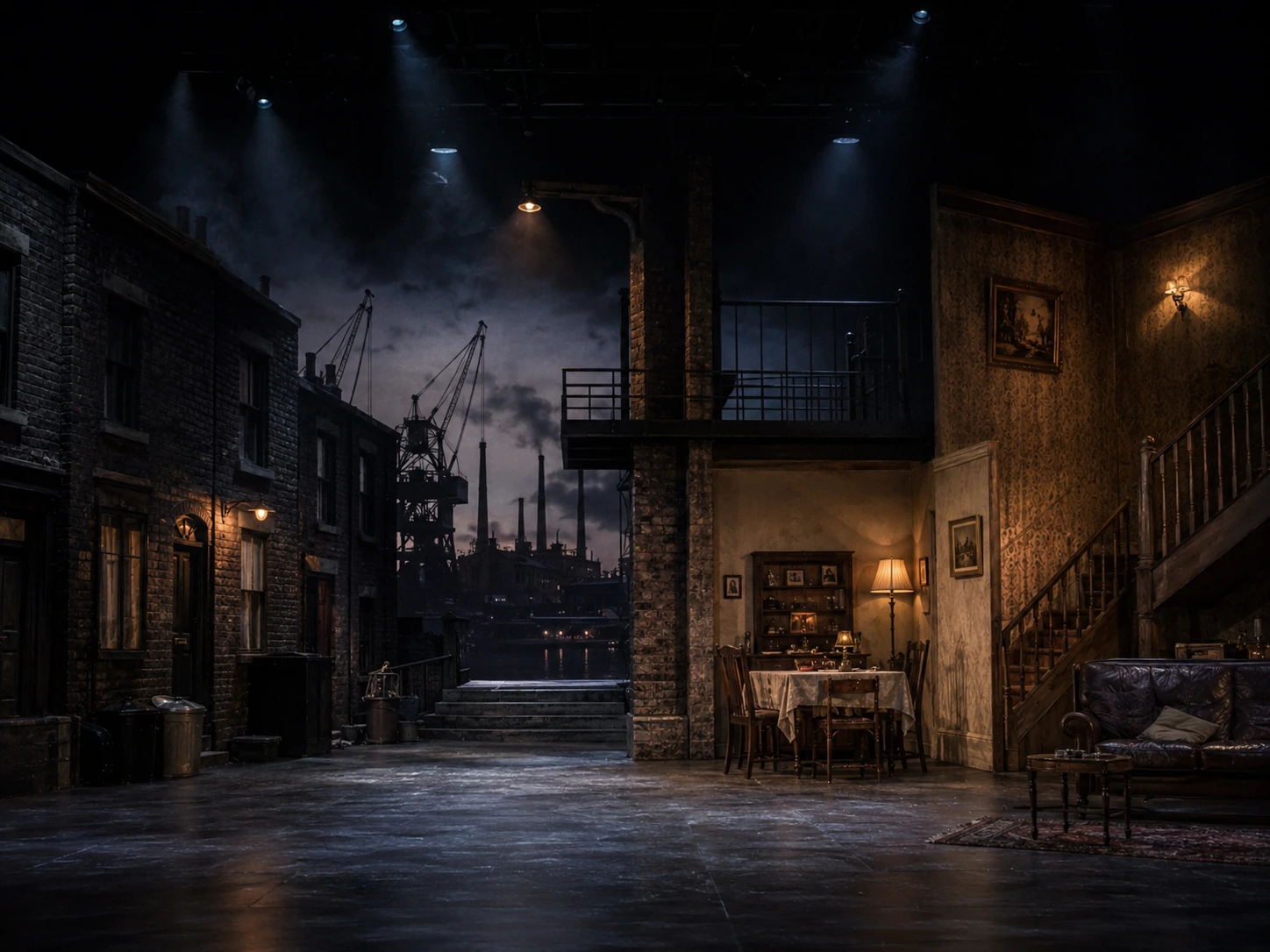
Look closely: Which parts of the environment would most strongly affect Mickey’s choices and confidence?
Willy Russell’s Anger
Willy Russell wrote the play in 1981, during a period of political unrest, riots, and soaring unemployment in Liverpool. The play attacks the myth that “anyone can succeed if they just work hard.” Russell uses Mickey to show how the British class system rigs outcomes.
.jpg)
Interactive: The Changing Face of Liverpool
Click to see how the political landscape shifts during the boys’ lives.
🏭 Traditional Industry
When Mickey and Eddie are children, Liverpool is a booming port city. Working-class men have steady jobs in factories and on the docks. There’s a stronger sense of community and hope.
🏘️ Slum Clearances
The Johnstone family relocates to Skelmersdale (“the country”). This reflects 1960s policies moving families from overcrowded slums into new council estates to offer a “fresh start.”
📉 Thatcherism & Unemployment
Margaret Thatcher becomes Prime Minister in 1979. Traditional industry declines and unemployment rises. “The sign of the times is a redundancy letter.” This pressure helps destroy Mickey’s pride and stability.
🎓 The Education Divide
Edward’s education protects him: higher opportunity, stable work, political power. Mickey’s underfunded school and limited prospects leave him exposed when the factory closes.
Context → Marks (use this in an answer)
Model paragraph (copy the structure)
Pick an era above to generate a model paragraph that links context to a practical theatre choice.
⭐ The Marilyn Monroe Motif
Russell references Marilyn Monroe as a tragic metaphor for both Mrs Johnstone and Mickey. A useful response often analyse this clearly.
In the Prologue, Mrs Johnstone compares her youth to Monroe. It represents hope and glamour that poverty erodes.
Monroe becomes a symbol of depression and reliance on pills. Mickey’s dependence mirrors this trajectory.
Monroe’s death foreshadows the play’s fatalism: the boys can’t escape structural pressure and consequence.
📝 Context Terminology Bank
Nature vs. Nurture
The central debate: are we defined by genetics (nature) or environment/class (nurture)? The twins suggest class environment shapes fate.
The Cycle of Poverty
The idea of structural repetition: limited opportunity reproduces the same outcomes across generations.
Superstition
Mrs Johnstone’s belief (“shoes upon the table”) shows limited control/education. Mrs Lyons weaponises this fear to manipulate her.