Costume Design
Uniformity, status, and physical decay
Turn the interpretation into your own design
Open the standalone Costume Lab and choose DNA to compare contemporary costume interpretations, group identity and what the audience can read from the stage picture.
Open Costume LabText source: DNA by Dennis Kelly. Any short script phrase on this page is used to support a practical costume choice.
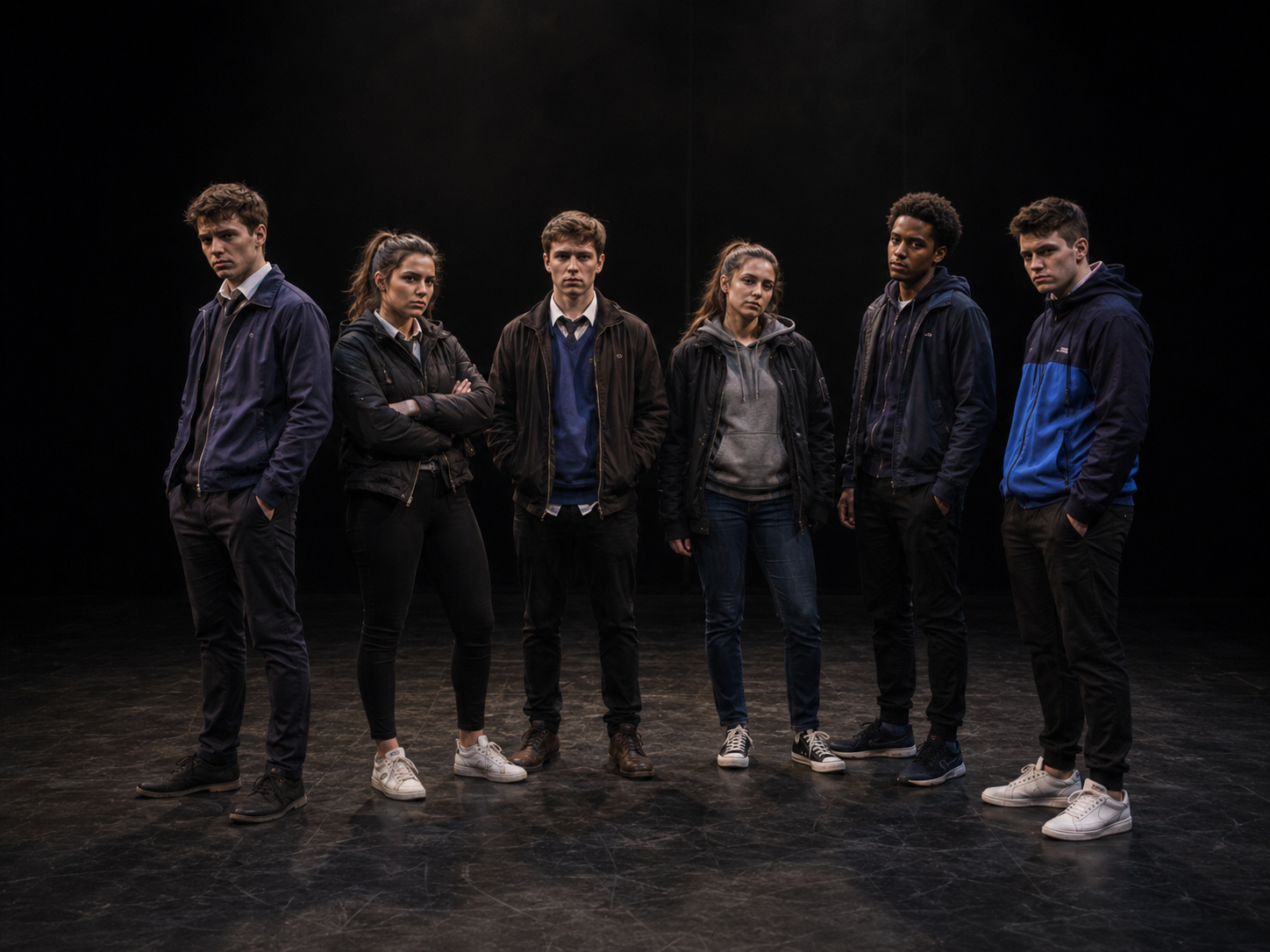
Make contemporary costume earn its place
Don’t write “they wear normal clothes”. Show how costume communicates status and psychological breakdown. Even in a uniform, the *way* it’s worn reveals hierarchy. Across the play, track dirt, creasing, and distressing to show loss of innocence.
The School Uniform Concept
Uniform creates “pack” instantly. Then hierarchy appears in micro-differences: fit, neatness, restriction, and comfort.
👔 John Tate (The Enforcer)
Pristine but slightly oversized. Broad-shouldered blazer makes him look larger and more imposing. Tie perfectly knotted: he is desperately trying to maintain control and order.
👔 Phil (The Strategist)
Comfortable, almost like pyjamas: oversized thick jumper instead of blazer, no tie. Shows disregard for rules and relaxed detachment in the face of crisis.
👔 Brian (The Victim)
Uniform slightly too small / tightly buttoned to the top. Physically restricts him, making him look vulnerable and suffocated by the pack’s pressure.
The Streetwear / Hoodie Concept
2007 “youth culture” streetwear becomes armour: concealment, image, and status symbols.
🧥 Cathy (The Risk-Taker)
Bright, expensive-looking trainers and pristine branded tracksuit. Shows apathy: she treats the situation as drama and status, not reality.
🧥 Leah (The Conscience)
Brighter, mismatched outfit (e.g., colourful cardigan over band tee). The chaotic palette mirrors frantic energy and her need to be noticed by Phil.
🧥 Phil (The Shadow)
Dark monochrome palette (black/charcoal). Hoodie up obscures face, masking emotion and making him a shadowy, unreadable presence.
Tracking Physical Decay
Costume shows time and psychological toll. Breakdown (dirtying, ageing, distressing) is technical and exam-friendly.
🩸 Adam’s Return (Act 3)
Heavy breakdown: caked dried mud (e.g., Fuller’s Earth) on knees/elbows; rust-toned stains suggesting dried blood. Makes him feral and barely human.
🩸 Brian’s Breakdown
Act 1 pristine → Act 2 wrinkled/untucked → Act 3 misaligned (wrong buttons), stained from cowering on woodland floor. Costume becomes a map of collapse.
🩸 Phil’s Immunity
In contrast, Phil stays pristine. Physical cleanliness mirrors emotional remorselessness and detachment from consequence.
📝 AO3/AO4 Response Builder
Edexcel-specific phrasing is used when Edexcel is selected; otherwise the tool gives general theatre-design guidance.
| Design Element (What) | Impact Justification (Why) | Key Terminology |
|---|---|---|
| Brian’s shirt buttoned tightly to the top collar, which becomes untucked and stained with stage dirt by Act 3. | The tight collar restricts him physically, showing suffocation under pack pressure. The gradual dirt and dishevelment maps his psychological breakdown visually. | Breakdown Distressing Condition Character arc |