Context & History
The dual context: Salem (1692) and the Red Scare (1950s)
The Political Allegory
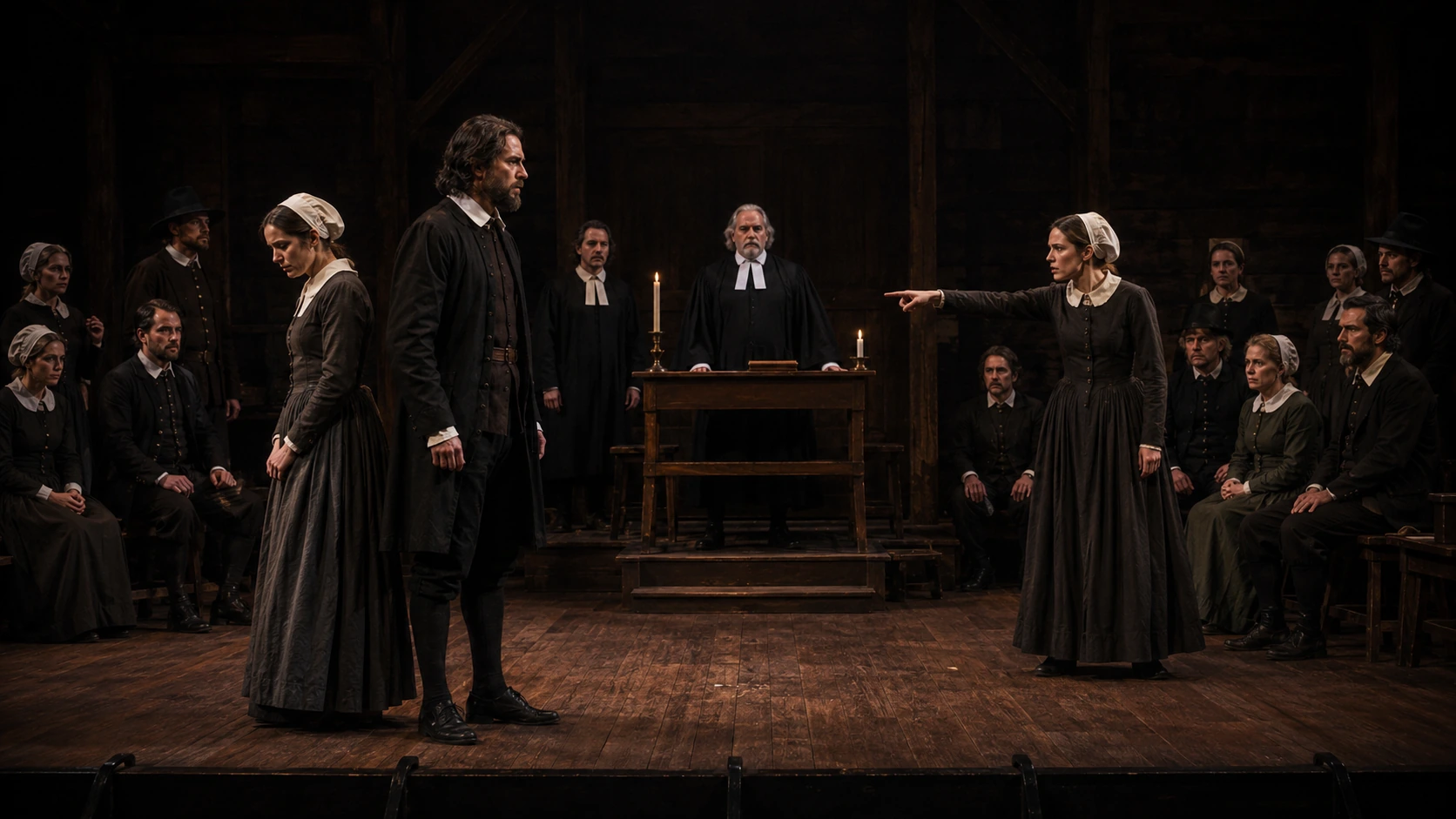
Miller wrote The Crucible in 1953. To score well, you must handle the play’s dual context: it dramatises the real 1692 Salem Witch Trials, but it also functions as an allegory for anti-Communist paranoia and “naming names” in 1950s America. Context only earns marks when you convert it into stage choices.

Exam focus: how to use context (not just “know” it)
Set your exam board to see what the selected board’s task rewards when you apply context to performance and design.
Interactive: The Allegory Decoder
Click the buttons to see how 1692 mirrors 1950s America — then translate that into acting, directing, and design choices.
Witchcraft & the Devil
For Puritans, the Devil is real. Witchcraft is an “invisible crime” with no evidence — accusation becomes proof, so hysteria can escalate without restraint.
Religious Oppression
Salem is a theocracy. Church = law. Joy is suspicious. That repression primes the community for moral panic and scapegoating.
Naming Names
Confession saves you — if you accuse others. Survival becomes betrayal. The system feeds itself by forcing people to widen the net.
Danforth & Absolutism
Danforth’s logic is binary: with the court or against it. Doubt becomes “treason” — the perfect engine for injustice.
Communism & the Red Scare
Cold War paranoia framed “sympathy” as guilt. Like witchcraft, suspicion alone could destroy lives — careers, reputations, safety.
HUAC & Blacklisting
Committees interrogated citizens about “loyalty”. Those labelled “un-American” were blacklisted — social death without legal proof.
Naming Names
Miller was called before HUAC and refused to identify others. That moral stance parallels Proctor’s choice to protect his “name”.
McCarthy & Fear Power
McCarthy claimed lists of “known Communists”. Like Danforth, he leveraged fear as a tool of control and political influence.
🎭 Applying context in the exam
For Acting
Salem’s theocracy polices bodies. Build performance from restraint (rigid posture, minimal touch, controlled eye focus) into rupture (ensemble hysteria, shouting, collapsing levels). The contrast is where the terror lives.
For Set & Costume
Puritan design should feel heavy and unforgiving: drab wool/linen palettes, timber beams, austere spaces that compress the actors. The world should look like a moral prison — ideal for showing pressure and surveillance.
The Symbolism of the Forest
For Puritans, the forest is the unknown: danger, temptation, “the Devil’s last preserve”. Let outside light feel cold or threatening; use shadows or distant sound to suggest a world beyond control.
Synopsis & Journeys
From whispered rumours to the gallows.
Context & History
1692 Salem, Puritanism, McCarthy allegory.
Characters & Acting
Status, control, and ensemble hysteria.
Key Scenes & Proxemics
Forest / farmhouse / courtroom / jail staging.
Themes & Quotes
Reputation, fear, authority — performance-led.
Design Elements
Set / lighting / sound / costume.